
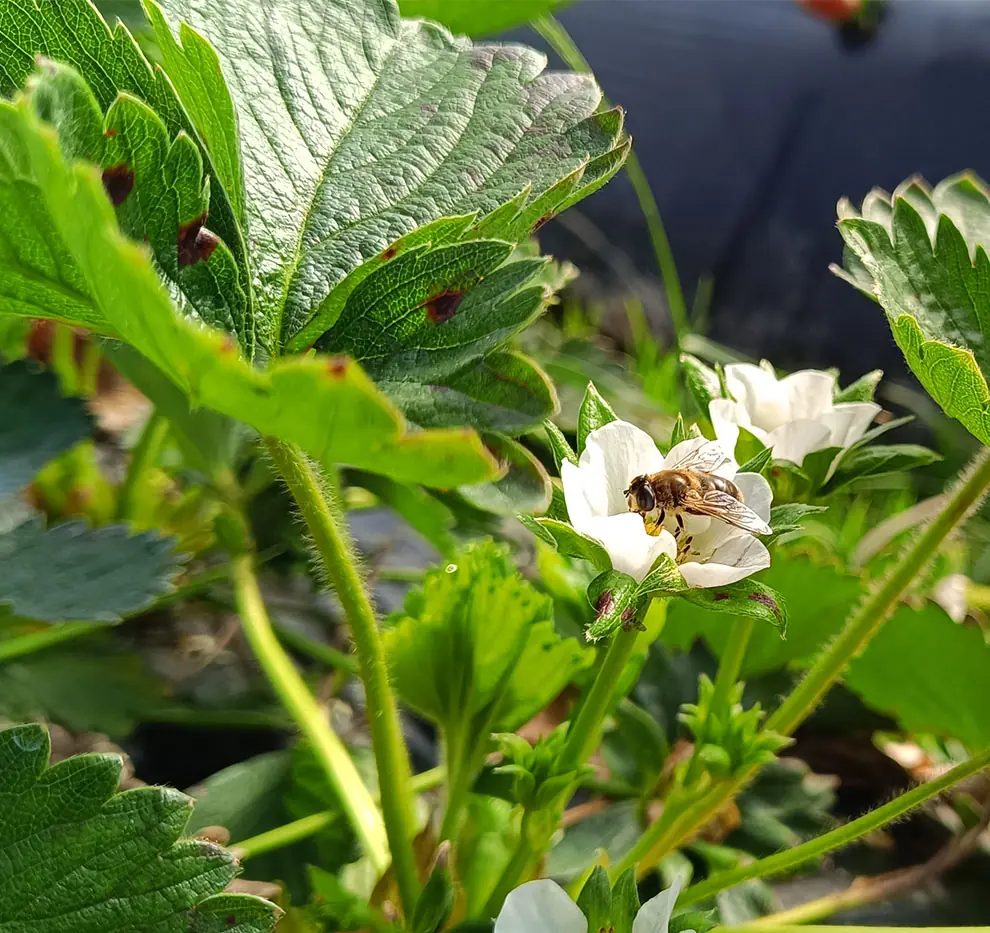
Polyfly, a start-up from Almería, rears hoverflies as commercial crop pollinators. It has won one of three Innovation Hub Awards at Fruit Attraction 2026 in Madrid.
The awards were presented on the final day of the show on 8 October, after nine finalists pitched to a jury. Polyfly took the fruit and vegetable industry category for its project Polyfly: Sírfidos Polinizadores (“pollinating hoverflies”). Each winner receives €2,000.
The other winners were:
- UNICA, in the fresh produce category, for Popits®, a bite-sized cucumber.
- AIMPLAS, in the sustainability category, for compostable separators for premium olive oil packaging, made from olive grove prunings.
A new kind of managed pollinator
Growers have used bees and bumblebees in greenhouses, especially for tomatoes, since the 1980s. Hoverflies are less familiar. Japan first proposed them for crop pollination in the 1970s, but nobody had bred them at commercial scale.
“Until now, no one had managed to breed them on a large scale for commercial use,” co-founder Marc Vaez-Oliveira told HortiDaily. He co-founded the company in 2017 with entomologist Dr Yelitza Velásquez.
Vaez-Oliveira also said the company isn’t trying to replace bees. Its hoverflies are meant “to serve as a complementary and sustainable natural pollination solution”. He acknowledged that existing pollinators “don’t meet the needs of all crops”.
Hoverflies don’t sting, so they’re easier to manage in enclosed spaces. They can also work in low light or under artificial lighting.
Polyfly sells two species:
- Queenfly® (Eristalis tenax): suited to cooler temperatures (10–30°C), low light, netted crops and early-season conditions.
- Goldfly® (Eristalinus aeneus): for warmer conditions (16–36°C) and densely flowering crops.
Polyfly lists strawberries, avocados, almonds, onions and vegetable seed production among its target crops. It has run validation work with Wageningen Plant Research in the Netherlands. The company says its trials have shown significant gains in yield and quality.

From pilot plant to a billion flies a year
Polyfly ran an 800m² pilot plant for more than five years before building what it describes as the world’s first industrial facility dedicated to mass-rearing hoverflies for pollination. The plant is in Huércal-Overa, Almería. According to HortiDaily.es, it has a potential capacity of more than one billion hoverflies a year and is now scaling up production.
The company already sells on four continents, with more sales abroad than in Spain. It describes the Almería plant as the first “node” in an international network, to be built through its own facilities or licensing deals with local partners.
Its backers include the European Innovation Council’s EIC Accelerator, which Polyfly won in 2023, followed by a Series A round in 2024. Earlier support came from Spain’s CDTI and ENISA.
Why it matters for growers
Many growers rely on a narrow range of commercial pollinators, so a stingless option that works in cool, dim conditions could be useful. That includes early-season strawberries under tunnels or netting, and crops grown under lights. The award puts Polyfly in front of the fresh produce trade at one of Europe’s biggest shows, just as its new plant is starting production.


Leave a Reply