
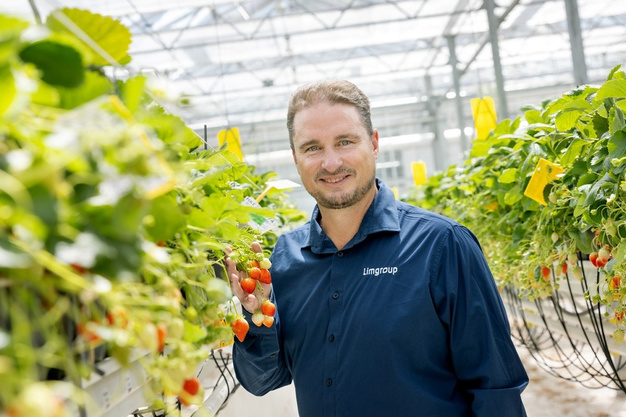
Dutch breeder Limgroup has introduced Limore Fizz, the latest variety from its F1 hybrid strawberry programme. Canadian growers will be the first to grow it commercially.
The variety was launched at the Canadian Greenhouse Conference last week. Limgroup is based in Horst, in the Netherlands, and is best known for asparagus and strawberry breeding.
What the variety offers
Limgroup describes Limore Fizz as:
- Sweet, with sugar content of 9–11° Brix
- Uniform, with glossy red, conical berries
- Stable in production, with high yield potential
- Easy to work, with vigorous plants and an open growth habit
“With Limore Fizz, we’ve brought together what matters most,” said Roland Sweijen, Product Lead Strawberry at Limgroup. He described those priorities as “great flavour for consumers, reliable performance for growers, and value throughout the supply chain.”
He added: “Growers will appreciate the variety’s vigorous plants and open growth habit.”
Limgroup says it evaluates hundreds of new selections every year. Each is tested under commercial conditions for yield, fruit quality, plant performance, shelf life and consumer appeal. “Only the most promising candidates progress through this process,” the company said.
After Canada, Limgroup says it sees potential to take the variety to other regions in the coming years.
Why seed-grown strawberries matter
Most commercial strawberries are still propagated from runners, which are cuttings taken from mother plants over several generations. F1 hybrids work differently: they are grown from seed. Limgroup says it was the first to bring an F1 hybrid strawberry to the professional market. Strawberries are octoploid, with eight sets of chromosomes, which makes hybrid breeding very difficult. Limgroup has been working on it for more than 15 years.
The company has set out the advantages before. Speaking to HortiDaily in 2024, Limgroup strawberry specialist Sjoerd Gipmans explained that runner propagation takes around three years. As a result, growers often order plants about 18 months ahead. Starting from seed cuts that to about 16 weeks.
Seed also gives every plant the same starting point. That should mean more even crops and a more predictable harvest. “Each seed, on the other hand, has the same starting point,” Gipmans said. CEO Vincent Deenen added: “Seed is clean and requires 100% clean cultivation.”
For growers, especially those in glasshouses or vertical farms producing all year round, that means they could react faster to demand from buyers rather than planning stock a year and a half in advance.
Related: https://the-fresh-edit.com/2026/10/06/fall-creek-easy-rose-pink-raspberry/


Leave a Reply