
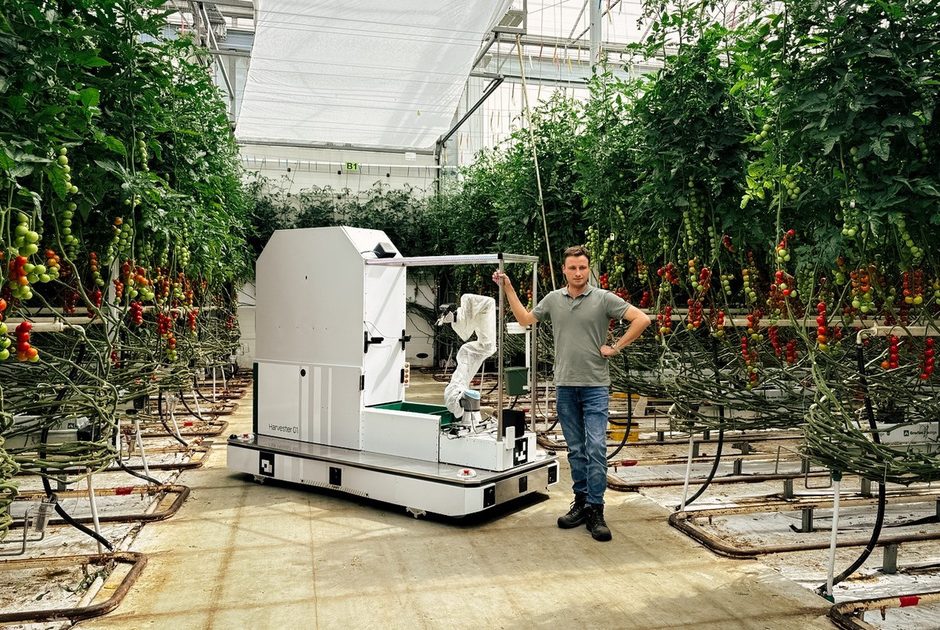
German agritech start-up eternal.ag is scaling its autonomous tomato-harvesting robot after its first commercial deployment with Dutch grower Van Noord Growers, putting the technology to work against one of greenhouse horticulture’s most persistent challenges: labour availability.
A new generation of greenhouse robotics is moving beyond demonstrations and into commercial production, with German start-up eternal.ag expanding deployment of its autonomous Harvester robot at Dutch grower Van Noord Growers.
The robot, designed specifically for harvesting truss tomatoes, has been operating at Van Noord’s 8.5-hectare site in Zeeland since September 2025. Following the initial deployment, Van Noord is expanding its fleet to three Harvesters.
For eternal.ag, the move is an important test of whether autonomous harvesting can deliver consistently enough in a commercial greenhouse to become part of day-to-day production rather than simply an automation showcase.
The company launched Harvester publicly in March 2026 alongside an €8 million funding round backed by Simon Capital, Oyster Bay Venture Capital, EquityPitcher Ventures and Backbone Ventures.
Designed around the greenhouse, not around the robot
Harvester uses computer vision and AI to identify plant height, canopy structure, tomato trusses and ripeness before making the cut.
Eternal.ag says the robot can operate for up to 22 hours a day, with autonomous navigation between greenhouse rows and a specialised end effector designed to cut trusses without damaging them.
The company claims a capacity of up to 120 trusses per hour.
Those figures are manufacturer specifications rather than independently verified performance benchmarks, and commercial results will depend on crop structure, greenhouse layout, harvesting requirements and operating conditions.
One of the more significant design choices is that eternal.ag says the robot can be introduced into existing greenhouse infrastructure without requiring growers to redesign their production system.
That could be important commercially. Retrofitting automation into an established greenhouse can be considerably more attractive than investing in new infrastructure specifically designed around a robot.
The labour problem is the business case
The technology is aimed at a very specific production challenge.
Harvesting tomatoes is repetitive, physically demanding work that has traditionally relied heavily on manual labour. Greenhouse operators need workers available at the right time as crops reach harvest maturity, making labour availability a production variable as well as an HR issue.
Van Noord Growers’ decision to expand its deployment suggests the company sees automation as a longer-term operational strategy rather than simply a technology trial.
Jeffry Van Noord, co-owner of Van Noord Growers, said the business expects labour availability to become increasingly constrained over the next decade.
“That’s why we are already scaling automation and intend to extend this across other greenhouse functions and crops.”
For growers, that distinction matters. A robot does not need to eliminate every manual task to have commercial value. If it can reliably take on a defined proportion of harvesting work, it could allow human workers to be concentrated on activities where flexibility, judgement or dexterity remain difficult to automate.
From virtual greenhouse to real crop
Eternal.ag is also betting on the way its robots are developed.
The company uses a simulation-first approach, training and testing its systems in virtual greenhouse environments before deploying them on real crops.
Renji John, CEO and co-founder of eternal.ag, says this allows the company to identify failures and iterate more quickly before putting hardware into a commercial greenhouse.
“Once deployed, every robot action feeds data back into the system, which is designed to learn, improve and scale.”
The approach is particularly relevant to horticulture because greenhouse environments are highly variable.
Plants do not grow identically. Canopies change throughout the season, fruit can be obscured by leaves and stems, and the robot must operate without damaging either the crop or the greenhouse infrastructure.
Research into greenhouse harvesting robotics continues to focus heavily on those problems, particularly machine vision, fruit recognition and robotic manipulation under conditions where produce can overlap or be partially hidden.

A commercial deployment is a more meaningful test
There is no shortage of greenhouse robots capable of performing individual tasks in controlled demonstrations. The harder question has always been whether they can deliver economically and consistently over an entire commercial growing cycle.
That is why the Van Noord deployment is more significant than another technology demonstration.
The grower is already operating one Harvester alongside its existing workforce and is now moving towards three units. Eternal.ag says the first robot was integrated into the operation without requiring changes to the greenhouse.
The company has not publicly disclosed the commercial terms of the agreement or detailed labour-cost savings generated by the robot.
That leaves some important questions unanswered for growers considering similar investments: the capital cost of each unit, payback period, maintenance requirements, utilisation, crop losses and the proportion of total harvesting that can realistically be automated.
Those figures will ultimately matter more to growers than headline operating hours.
The technology is being built to expand beyond tomatoes
Eternal.ag is positioning Harvester as the first part of a broader robotics platform rather than a standalone machine.
The company says its modular system is intended to support additional robotic functions and, eventually, other crops.
Its longer-term vision is for more greenhouse tasks to be handled autonomously, reducing the number of repetitive manual operations required inside high-tech growing facilities.
That ambition is still some way from being realised.
For now, the immediate test is much narrower: can a relatively small robotics company make autonomous tomato harvesting reliable enough that a commercial grower wants more robots?
Van Noord Growers’ expansion from one Harvester to three provides an early indication that the answer may be yes.
But the real measure will be sustained performance across multiple seasons and growing conditions.

Robotics becomes an operational decision
For commercial greenhouse growers, the arrival of Harvester reflects a wider change in how automation is being considered.
The question is no longer simply whether a robot can pick a tomato. It is whether automation can become part of the production system without creating a new set of costs and operational complications.
That means reliability, integration, maintenance, energy use, crop damage, software performance and return on investment all become as important as the robot’s ability to recognise a ripe truss.
Eternal.ag’s approach — starting with one specific crop task, deploying it commercially and expanding from there — provides a useful test case for the sector.
If the technology performs consistently at Van Noord Growers, the implications extend beyond one German start-up and one Dutch greenhouse. It would provide further evidence that autonomous robotics can move from the technology-development stage into the daily economics of commercial horticulture.
For an industry facing a tightening labour pool, that may ultimately be the more important milestone than the launch of the robot itself.
Sources: eternal.ag, Van Noord Growers, European Comission CORDIS, Agriculture Research


Leave a Reply