
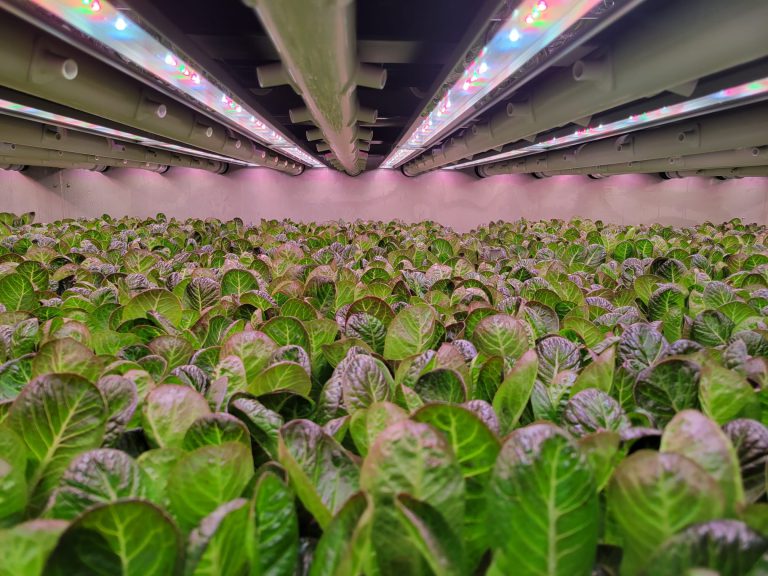
Canadian vertical farming company Elevate Farms is planning a 2,400 m² leafy-greens facility in Sharjah as part of a new commercial testing and technology-development partnership aimed at accelerating controlled-environment agriculture in the UAE.
Elevate Farms has partnered with UAE-based Tathmeer Agri Tech to bring its autonomous vertical farming technology to Sharjah Research, Technology and Innovation Park (SPARK), with the planned facility expected to produce around 400 tonnes of leafy greens a year.
The agreement, announced on 1 October, forms part of Tathmeer’s new Integrated Agri-Tech Innovation Centre, which is intended to combine vertical farming, hydroponics, artificial intelligence, applied research, technology testing and routes to commercial deployment.
For the vertical farming sector, the significance is broader than the proposed farm itself. The initiative is designed around testing technology under operating conditions before growers and investors commit to larger-scale deployment — an approach that could address one of controlled-environment agriculture’s persistent commercial problems: proving that a technology works economically, not simply technically.
A vertical farm designed for a water-constrained market
Elevate said its planned Sharjah farm will occupy approximately 2,400 m² and is expected to produce about 400 tonnes of leafy greens annually.
The company estimates that the operation could use approximately 95% less water than field farming, including processing and facility cleaning. Elevate says this would save an estimated 95 million litres of water and avoid the use of around 12 hectares of farmland each year.
Those figures are company projections rather than independently verified performance data for the planned Sharjah facility. They should therefore be viewed as targets attached to the proposed project rather than demonstrated results from the site.
The economics of water use are nevertheless particularly relevant in the UAE. The country’s national food-security strategy calls for sustainable, technology-enabled domestic production, while its national sustainable agriculture programme includes reducing irrigation water use and improving farm efficiency among its objectives.
That creates a potentially strong use case for controlled-environment production of crops such as leafy greens, where a predictable year-round supply can be combined with highly controlled water and nutrient delivery.
From technology demonstration to commercial deployment
The new Integrated Agri-Tech Innovation Centre is intended to provide a physical environment where agricultural technologies can be demonstrated and tested before wider investment.
Tathmeer says the centre will bring together controlled-environment agriculture, hydroponics, vertical farming, automation, IoT and AI-enabled monitoring, alongside research, training and market-access functions.
That model is notable because it shifts some of the risk away from individual growers.
A commercial operator considering a vertical farm typically has to make major decisions around growing systems, lighting, automation, climate control, energy supply, crop selection and software before there is much operational data from the proposed site.
A shared testing environment can potentially allow those systems to be evaluated under local conditions first. In the UAE, that means testing against the particular combination of high ambient temperatures, water constraints, energy requirements and local market conditions that a supplier’s overseas demonstration may not fully represent.
For growers, the value is therefore not simply access to another vertical farming system. It is the possibility of getting better evidence before committing capital.
Elevate is taking a technology-plus-production approach
The Sharjah project also follows a strategic shift at Elevate Farms.
Earlier this year, the company acquired Canadian controlled-environment grower Fieldless Farms, making the business a wholly owned subsidiary. Fieldless operates a commercial leafy-greens operation in Cornwall, Ontario, supplying the Canadian market.
Elevate now describes itself as both a technology platform and operator, rather than simply a supplier of vertical-farming equipment.
Its technology is based around automated indoor production, while Fieldless provides an established route into commercial fresh-produce production and retail.
The company says it has three operating facilities across Canada, the US and Switzerland and is now pursuing international expansion.
That background matters to the Sharjah project. The UAE partnership is not being presented as a laboratory-only installation; Elevate is bringing an operating model alongside its technology.
Amin Jadavji, chief executive of Elevate Farms, said Canada and the UAE face different climates but share a challenge of producing fresh food locally throughout the year with less dependence on long supply chains.
“Our work with Tathmeer and SPARK is an opportunity to bring proven vertical farming technology and operating expertise to the UAE,” he said.
Why the UAE is becoming an important CEA market
The UAE has spent years looking at technology as a means of strengthening domestic food production.
Its National Food Security Strategy 2051 identifies technology-enabled sustainable production and stronger local supply as key priorities, while also seeking to diversify food-import sources.
For commercial growers, the attraction of vertical farming in this environment is not necessarily the replacement of conventional agriculture. It is the ability to produce selected high-value or perishable crops in a tightly controlled environment despite constraints on land, climate and water.
Leafy greens are particularly suited to that proposition because they have relatively short crop cycles and can be grown in stacked hydroponic systems.
But the same commercial questions facing vertical farming elsewhere remain relevant in Sharjah: electricity costs, capital expenditure, labour requirements, crop pricing, utilisation and reliable routes to market will ultimately determine whether the production model works at scale.
The proposed centre could therefore provide something more valuable than another showcase farm: locally generated operating data.
A test for the next phase of vertical farming
The UAE project comes at a time when the vertical farming industry is becoming more selective about where indoor production makes economic sense.
The focus is increasingly shifting away from simply demonstrating that crops can be grown indoors and towards proving that facilities can produce consistent commercial yields while controlling energy, labour and input costs.
That makes Sharjah an interesting market for the next stage of the industry.
If Elevate’s proposed facility performs as planned, it could provide a local reference point for retailers, growers and investors considering controlled-environment production in the Gulf.
For the wider industry, the more important development may be the infrastructure around it: a facility where technologies can be tested, operators can gather production data and investors can assess projects before committing to full commercial deployment.
That could prove just as important to the future of vertical farming as the growing technology itself.
Sources: Elevate Farms; Tathmeer Agri Tech; UAE Government National Food Security Strategy 2051; UAE Government food-security and sustainable-agriculture information.


Leave a Reply