
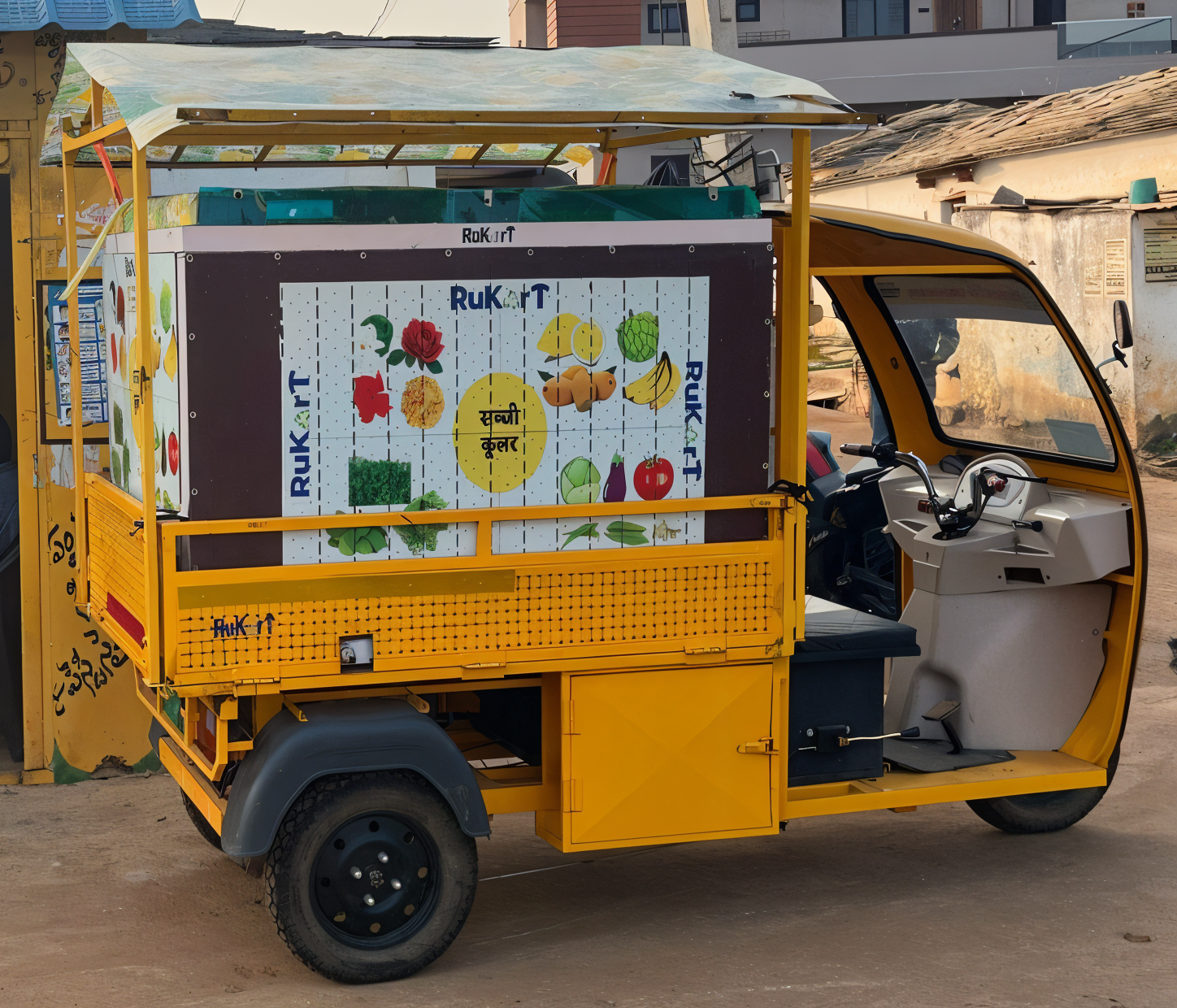
For many smallholders and market traders, refrigeration isn’t an option. It costs too much to buy and to run, and in many places the power supply is unreliable. Indian start-up RuKart has built coolers that don’t need electricity at all.
Its patented Subjee Cooler and ZEN systems use what the company calls “Enhanced Evaporative Cooling”. It’s a passive process with no compressor and no refrigerant that keeps produce below the outside temperature. Subjee is a common Hindi word for vegetables.
Speaking to FreshPlaza, co-founder Vikash Jha said the idea was to make storage pay for itself. He developed the core cooling principle while at IIT Bombay. “We saw an opportunity to extend storage life without adding costs that are difficult to recover through produce sales,” he said.
How it works
The coolers run on water rather than power. “Water is required, but around 80% can be collected and reused,” Jha said. RuKart says a 100kg model uses about 1,050 litres of water a year.
The range includes:
- Small units for shops and households
- Portable models for storing and pre-cooling produce on farms
- A mobile version built for transport
“The cooling systems are sold as a one-time investment, with no electricity costs or compressor-related maintenance,” Jha added.
The results so far
Since October 2019, RuKart has installed more than 2,500 units across 24 Indian states. Customers include the Sahaja Organic Farmer Producer Organization and Organic Mandya, as well as individual farmers and retailers.
The company says independent impact assessments have found:
- 17–22% less produce lost, on average across installations (this varies by crop and conditions)
- 30–50% higher incomes for farmers
- ₹500–1,000 extra a day for retailers
Co-founder Sharayu Kulkarni explained the thinking behind the business model: storage “that costs less to operate could make it more practical to hold produce for longer”. Farmers and traders don’t have to sell everything the day it’s picked.
A practical piece of a global problem
Food loss between harvest and the shop is a global challenge. The UN Food and Agriculture Organization’s State of Food and Agriculture 2019 report estimated that around 14% of the world’s food is lost at that stage. RuKart’s goal is to cut post-harvest losses of fruit, vegetables, flowers and dairy in the developing world to below 5% by 2030.
RuKart is clear about what the technology isn’t. It isn’t designed to replace conventional cold storage for large exporters, pack-houses or long-distance shipments that need tight temperature control. Its focus is the first and last mile, where most smallholders currently have no cooling at all.
Image: RuKart, Powering Livelihoods


Leave a Reply