
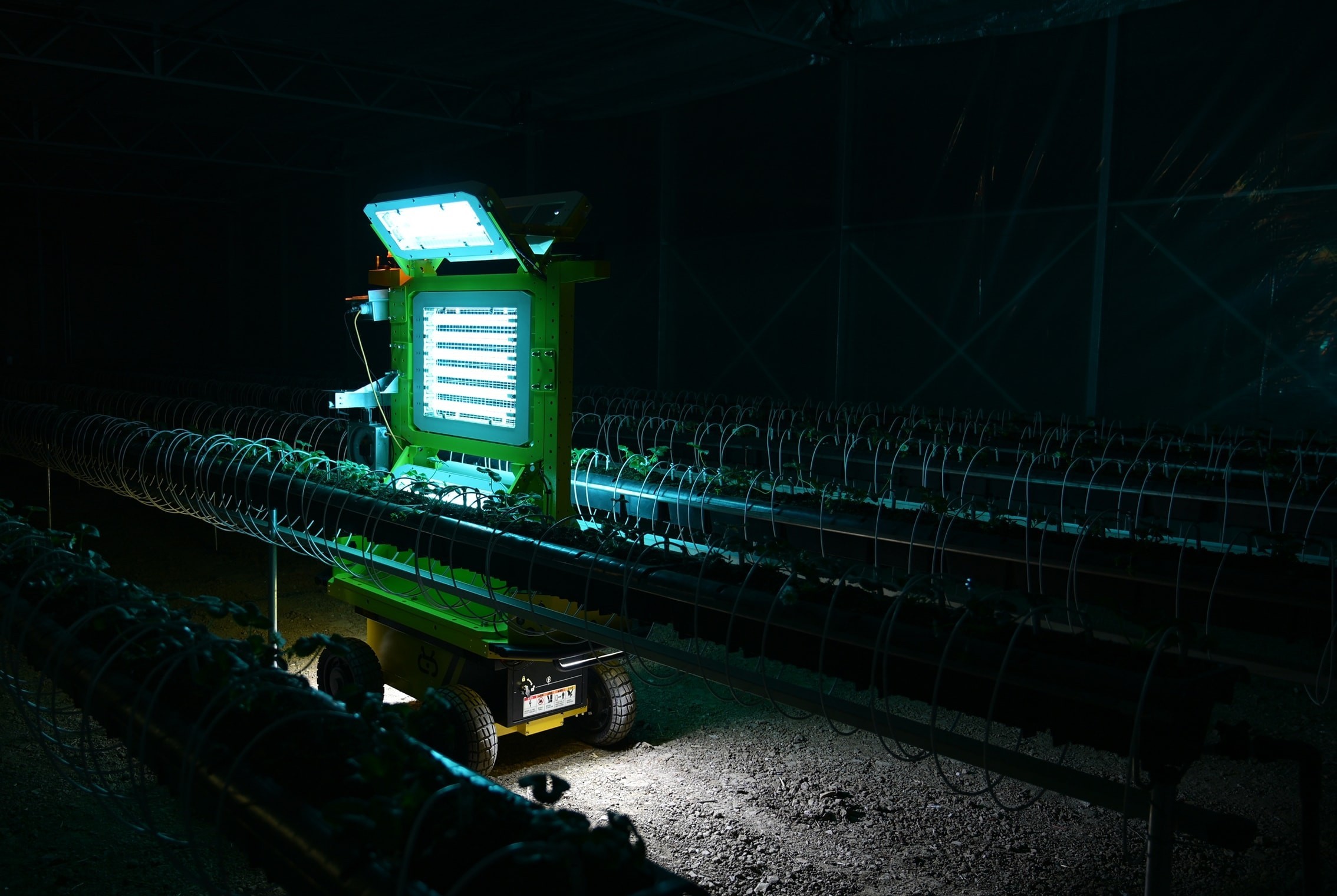
Powdery mildew is one of the most persistent diseases in strawberry production, especially under tunnels and glass. For years, the main answer has been regular fungicide sprays. Now a growing number of growers are trying something different: ultraviolet (UV-C) light, applied at night, often by robots.
This guide explains how it works, what the research says, and what growers should consider.
What is UV-C?
Ultraviolet light is split into bands by wavelength. UV-C is the shortest and most energetic. It’s the same type of light used to disinfect water, surfaces and air, because it damages the DNA of microorganisms.
The challenge is that a dose strong enough to kill a fungus in daylight can also harm the plant. The breakthrough came from understanding timing.
Why it works at night
Fungi can repair DNA damage caused by UV, but this repair process needs light to work.
Researchers at the Norwegian Institute of Bioeconomy Research (NIBIO), working with Cornell University, found that powdery mildew fungi effectively switch off this repair system in the dark. According to Cornell, that means a small dose of UV at night can kill the fungus without harming the plant.
The Australian Berry Journal explains that treatment followed by a dark period of two to four hours stops the pathogen repairing itself, so it can’t reproduce and dies.

What the research shows
- As good as fungicides: “In more than three years of trials, UV light applications worked as well as or better than available fungicides,” said David Gadoury of Cornell AgriTech, who led an international research team. The team reported that UV killed about 95% of powdery mildew on field strawberries.
- Short, regular doses: USDA researchers found that 60 seconds of UV-C at night, twice a week, matched the results of weekly fungicide sprays, according to the Australian Berry Journal.
- More than mildew: trials on strawberries have also shown control of grey mould (Botrytis) and black spot. USDA researchers reported success against two-spotted spider mite, greenhouse whitefly and spotted wing drosophila.
- Other crops: Cornell’s team has tested UV in field and greenhouse trials on basil, roses, grapes, rosemary and cucumbers as well as strawberries.
From lamps on carts to robots
Treating a field at night, twice a week, takes a lot of labour, which is why robots have become the main way of delivering UV-C. Companies building UV-C robots include:
- Antobot (Chelmsford, UK): autonomous UV-C robots for strawberries, used by Driscoll’s and Tiptree. See our Start-up of the Week feature.
- Saga Robotics: makers of the Thorvald robot platform, used in strawberry production
- TRIC Robotics: working with the USDA on a system for in-ground growers
- CleanLight: another UV-C robot maker
- Outback Robotics (Western Australia): developing a prototype for tabletop strawberries
Newer research is testing 222nm lamps and better reflectors, which allow much shorter exposures so robots can cover more ground each night.
What growers should consider
- It’s a tool, not a silver bullet. UV-C works best as part of an integrated pest management (IPM) programme, alongside good hygiene, ventilation and resistant varieties.
- Regular treatment matters. UV-C needs consistent, frequent application, typically twice a week in research trials.
- Safety: UV-C can burn skin and damage eyes, so treatments should only run when nobody is in the crop, which is another reason night-time robots suit it well.
- Cost and access: growers can rent robots as a service or buy them outright. Some companies are moving towards selling machines, helped by capital grants in some countries.
- Residues: because UV-C leaves no chemical residue, it can help growers meet retailer and consumer pressure to reduce pesticide residues.

Why it matters
The list of approved crop protection products keeps getting shorter, and residue limits keep getting tighter. A treatment that uses only light, delivered by a robot at night while the crop rests, is one of the most promising alternatives for soft fruit growers. With UK companies like Antobot already working commercially, it’s a technology British growers can try now, not someday.
A guide from The Fresh Edit. Last updated: October 2026.
Further reading
- Cornell: UV light may be ripe to replace chemicals in fungus fight
- Australian Berry Journal: UV-C, an emerging technology for strawberries
- Annual Review of Phytopathology: Shedding the light on powdery mildew
Related on The Fresh Edit: https://the-fresh-edit.com/2026/10/14/start-up-of-the-week-antobot/
Featured Image Credit: Antobot


Leave a Reply