
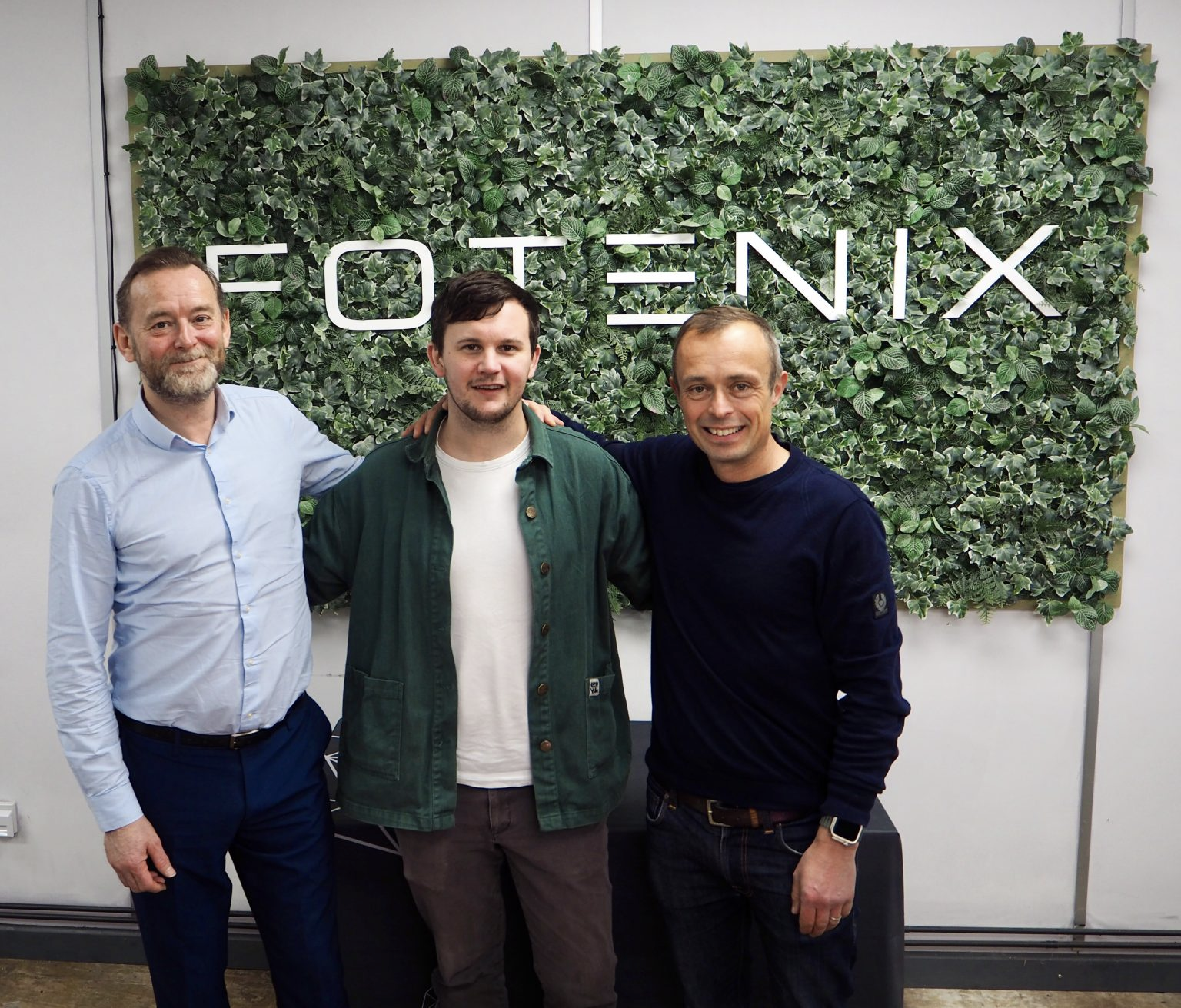
By the time a grower spots disease on a crop or a soft patch on a tomato, the damage is usually done. Manchester’s Fotenix wants to give growers an earlier warning.
At a glance
| Founded | 2018, as a University of Manchester spin-out |
| Co-founders | Dr Charles Veys (CEO) and Professor Bruce Grieve |
| Technology | Multispectral imaging, AI and 3D crop “digital twins” |
| Funding | £2.1m round led by River Capital’s Fund:AI, with support from EHE Venture Studio and Innovate UK |
| Latest project | QualiCrop automated tomato grading, with Leap AI, the University of Lincoln and APS Salads |
How multispectral imaging works
In 2018, University of Manchester spin-out Fotenix emerged to pioneer 3D multispectral imaging for agriculture. Co-founded by Professor Bruce Grieve and Dr Charles Veys, Fotenix developed the technology to mount on tractors, robotics or handheld devices.
Normal cameras see what we see. Multispectral imaging goes further. It analyses reflected light at selected wavelengths to identify changes associated with damage, disease and mould, including defects that may not yet be visible on the fruit’s surface. Fotenix combines multispectral imaging, robotics and AI to create 3D digital twins of crops, enabling growers to identify stress and disease long before visual symptoms emerge.
“When there’s something inside the plant or a fungal infection that a person can’t see, then they’re just not going to be able to detect it,” Veys told HortiDaily.
Why it’s in the news: QualiCrop
This autumn, Fotenix showed what its imaging can do on a packhouse line. Called QualiCrop, the system combines multispectral imaging with robotic handling to automatically separate healthy fruit from defective fruit with 87 per cent accuracy. The system was funded by Innovate UK and led by Fotenix in collaboration with Leap AI and the University of Lincoln.
The results so far:
- The integration trials took place from 27 to 29 July 2026, using tomatoes supplied by UK grower APS Salads.
- Fotenix’s imaging technology can classify up to 4,000 items per minute in commercial applications. During the integrated QualiCrop demonstration, the robotic sorting operation handled approximately 200 items per minute.
“The imaging is not so much the issue. It’s whether you want to act on that imaging,” Veys explained.
Backed to scale
Fotenix has raised £2.1 million in funding led by River Capital’s Fund:AI, with support from EHE Venture Studio and Innovate UK. River Capital’s investment director, David Walters, said the aim is to bring “the Fotenix technology to markets in the UK, EMEA and the USA.”
Our take
Fotenix is tackling one of UK agtech’s biggest challenges. Veys has spoken openly about it: “there’s a great environment for grant funding to develop technology but there isn’t support for the adoption.”
QualiCrop suggests Fotenix is focused on adoption. It has taken its imaging into a working packhouse with a major UK grower, alongside a robotics partner. If grading lines can catch hidden disease and mould before fruit leaves the packhouse, growers could cut rejections and waste, and protect their reputation with retailers. That’s a strong business case in any season.
Image Credit: University of Manchester Innovation Factory
Is your start-up changing UK horticulture? Email us to be considered for Start-up of the Week.


Leave a Reply