
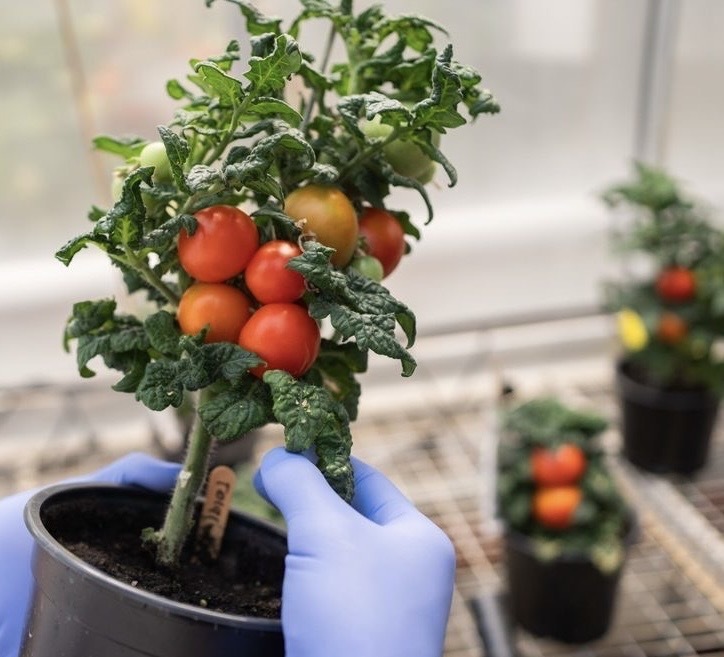
Two new gene-edited tomatoes developed in Hertfordshire can be grown outside the lab in England from today.
The UK government has published regulatory notices confirming two new gene-edited tomato lines developed by Phytoform, a precision-breeding company based at the Lawes Open Innovation Hub in Harpenden, Hertfordshire. The notices say the release will be made on or after 19th November 2026.
Two traits for the future of tomato growing
Each precision bred tomato line targets a different challenge:
- A compact plant for vertical farms: one line has a compact, dwarf growth habit suited to high-density vertical farming.
- Fruit that holds on: the other produces fruit that stays attached to the plant instead of dropping off, a trait aimed at mechanised and cluster harvesting.
Both traits address issues growers face every day: making the most of growing space, and making tomatoes easier to harvest by robot or by the truss.
What the notices mean
Both lines were filed under the Genetic Technology (Precision Breeding) Regulations 2025, the UK’s route for gene-edited crops that contain no foreign DNA. For both filings, Defra’s two required confirmations, that the line meets the legal definition of “precision bred” and that it will not be marketed before that status is confirmed, are both marked as satisfied.
That means the tomatoes can now be grown and assessed in England. They aren’t on sale yet: marketing them as food requires further steps.
The notices also explain how the tomatoes were made. Protoplasts were isolated from tomato seedlings and transfected with a site directed nuclease (SDN) enzyme and synthetic gRNA. In simple terms, the edits change the tomato’s own genes rather than adding DNA from another species.
A busy month for Phytoform
The tomatoes follow another recent milestone for the company. Defra published a release notice on 30 October 2026 confirming that Phytoform had met the requirements of the Genetic Technology (Precision Breeding) Act 2023 for its edited potato line, which is bruise-resistant.
Phytoform has been working on compact tomatoes for some time. In 2024, it said a miniaturised version of the Ailsa Craig variety can yield up to 400% more fruit over a year compared to traditional tomato crops, because its small size allows three growth cycles a year in a vertical farm. Earlier this year, a consortium including CambridgeHOK, the University of Lincoln, APS Group (the UK’s largest tomato grower) and Phytoform Labs secured almost £3m in government funding to develop miniature tomato varieties.
Why it matters for UK growers
The UK still imports most of its tomatoes. Compact plants could help vertical farms grow tomatoes economically for the first time, and fruit that stays on the truss would make robotic and cluster harvesting more practical. Both could help British growers produce more with less labour.
These trials are an early but important step. They show the UK’s new precision breeding rules starting to deliver real crops from British companies.
Sources: Defra precision breeding register


Leave a Reply