
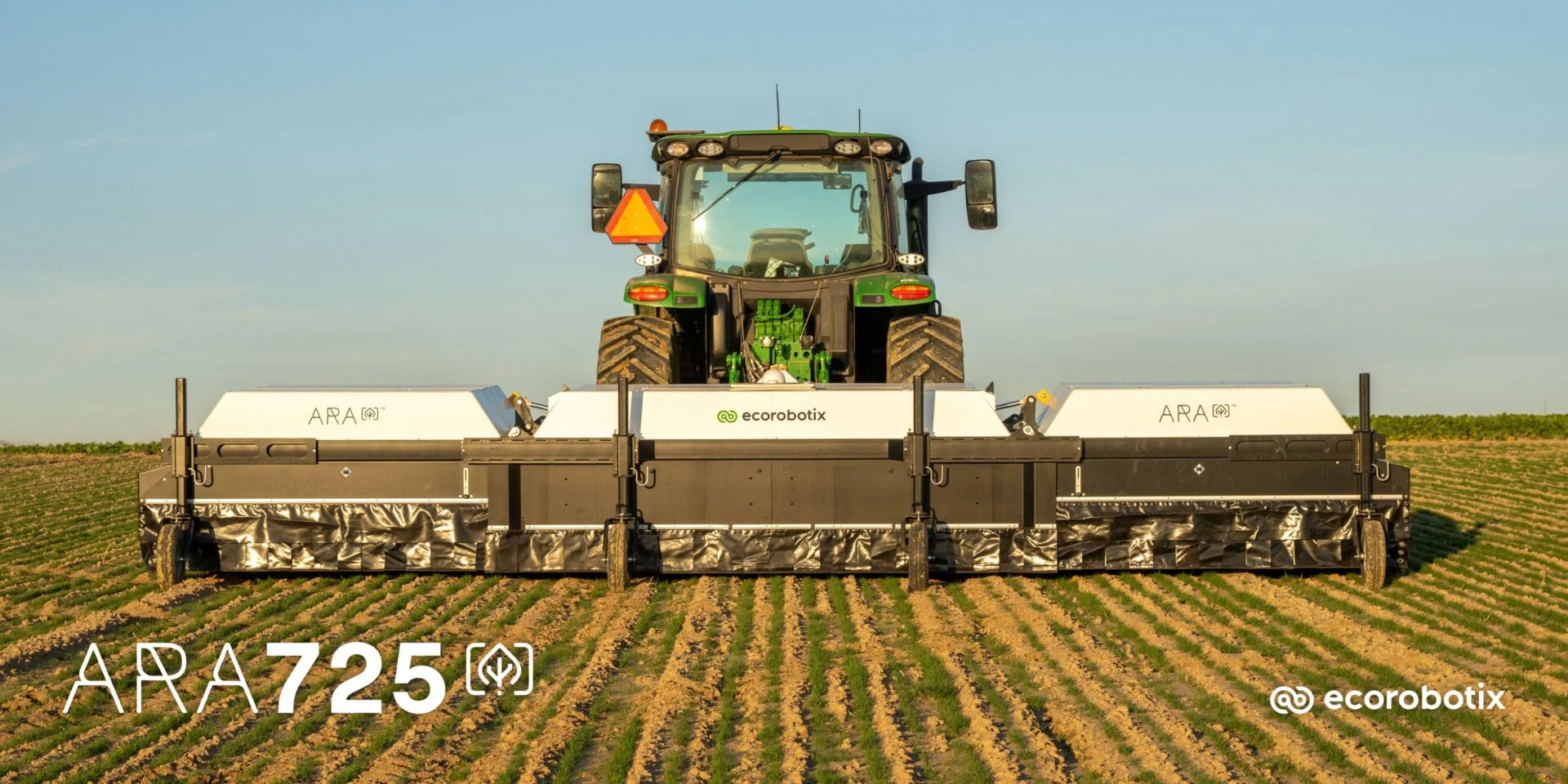
Swiss agtech company Ecorobotix has expanded its AI-powered spot-spraying system with a new, wider precision sprayer, the ARA725, and 10 new plant detection models that will let growers target weeds in more crops from next season, including leeks, garlic and potatoes.
Its ARA system uses cameras and artificial intelligence to tell crops from weeds, then sprays individual plants instead of the whole field. The company says this can cut crop protection product use by up to 95%.
The ARA725: built for wider beds
Announced on 3 November, the ARA725 has a 24-foot (about 7.25 m) spray width, with 180 individually controlled nozzles and seven vision boxes. Its central frame is one metre longer than the existing ARA620, to support the wider spray width.
Ecorobotix says the machine was developed in response to grower feedback, especially from onion growers in the US Pacific Northwest. It suits beds of 22, 34, 44 and 68 inches, depending on field layout and tractor track width. Target uses include straight-bed onions, pivot-irrigated fields, grass seed and sugar beet.
“With the ARA725, we continue to listen to our customers and translate their feedback into practical solutions,” said Sophie Rachmacher, Product Manager at Ecorobotix.
The ARA725 keeps the core technology of existing ARA sprayers and works with existing tank options.

Ten new crop models for 2027
A week earlier, on 29 October, Ecorobotix launched 10 new commercial plant detection models, available to growers from March 2027. The models the company has named include garlic, leek and potato. Growers can also test 55 upcoming models for free, including pepper, courgette and the weed yellow nutsedge.
That takes ARA to more than 120 recognition and treatment models in total.
Yellow nutsedge, a fast-spreading weed that is notoriously hard to control, is a highlight. An Agroscope study cited by the company found yield losses of 40% to 71% in Swiss sugar beet and potato fields.
“Yellow Nutsedge is an increasingly common problem across Europe,” said Simon Gasser, Agronomist and Crop Algorithm Product Manager at Ecorobotix. He added that the company is offering “the first precision spraying solution capable of detecting Yellow Nutsedge”.
What growers are seeing
According to Ecorobotix:
- crop models that reached commercial status were used on more than 11,000 hectares in over 20 countries in 2026
- they cut crop protection product use by an average of 86% compared with broadcast spraying
- area treated with its carrot model rose by more than 80%
- more than 1,000 ARA units are in use worldwide, and they have treated more than 600,000 hectares in total
Belgian potato grower Luc Détroz, who treated 300 hectares with the ARA potato model, said: “This clearly saved the crop. In a single pass, we were able to control goosefoot and knotweed.”
Why it matters for UK growers
Leeks, potatoes, carrots and brassicas are major UK field crops, and growers have fewer and fewer herbicide options. Spot spraying offers a way to use less product, and in some cases to use non-selective herbicides between crop plants where broadcast spraying would cause damage.
The UK’s Pesticides National Action Plan, which aims to reduce the environmental impact of pesticides by 10% by 2030, makes precision application more relevant still.
UK growers interested in the new models, or the ARA725, should check with Ecorobotix about availability, as the new sprayer was developed with North American bed systems in mind.
Source: Ecorobotix press releases, 29 October and 3 November 2026.
Image Credit: Ecorobotix



Leave a Reply